Due to my work, I often travel between the Qi Ming Wen Fang warehouse and my home. Sometimes when chatting with taxi drivers on the way to the warehouse, I’m frequently asked about my occupation. When I tell them I sell the Four Treasures of the Study, eight out of ten drivers will ask: “What are the Four Treasures of the Study? Which four items exactly?” Then I explain what they are, and our conversation naturally turns to calligraphy education in schools and their childhood experiences learning calligraphy.
Today, I looked back at my previous articles about the Four Treasures of the Study. Although I’ve covered a lot of related knowledge, I’ve never actually explained what the Four Treasures are or which four items they include. I’ve also never provided a complete introduction to them as a whole. So I decided to write this article to share some knowledge about the Four Treasures of the Study.
The Origin of the Name “Four Treasures of the Study”
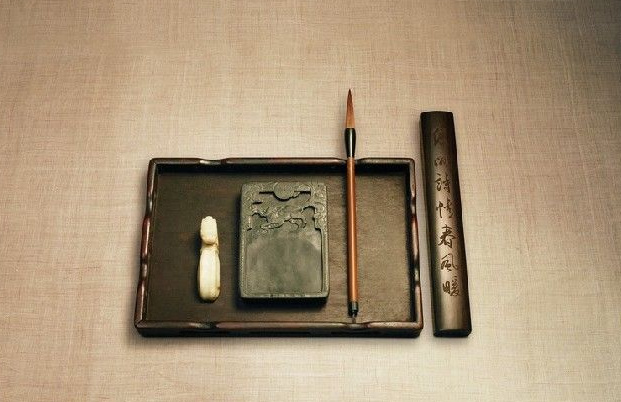
The Four Treasures of the Study, simply understood from the literal meaning, refers to four treasures or four items in a scholar’s study.
In ancient times, “study” (文房) referred to a scholar’s library or workspace. However, the original literal meaning of these two characters didn’t refer to a scholar’s study.
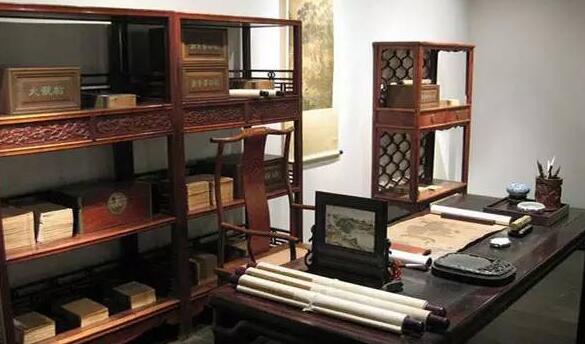
Study – The Workspace of Ancient Chinese Scholars
In “The Book of Liang: Biography of Jiang Ge,” it states: “This Duan Yong府 carefully selected talented individuals, and the positions in the study were given to your brothers.” From “positions in the study,” we can see that during the Northern and Southern Dynasties period, the study was an official government institution.
Later, the term evolved to mean a scholar’s study or workspace. Since studies often contained various small objects and decorations, the term also came to mean study supplies or became a shortened reference to the Four Treasures of the Study.
What we’ve discussed above is about the “study.” Now let’s talk about the “four treasures.” Qi Ming previously published an article titled “45 Elegant Study Objects (Absolutely Eye-Opening),” which mentioned more than forty common items found in ancient scholars’ studies.
The “four treasures” are the most commonly used and fundamental items among these many study objects: brush, ink, paper, and inkstone.
Of course, throughout history, the specific items referred to as the “Four Treasures of the Study” have changed somewhat. In different eras, the Four Treasures referred to different things.
During the Southern Tang Dynasty, the “Four Treasures of the Study” specifically referred to Zhuge brushes from Xuancheng, Anhui (at that time, Zhuge brushes were the best in the country – if they claimed to be second, no one dared claim to be first), Li Tinggui ink from Huizhou, Anhui, Chengxintang paper from Huizhou, Anhui, and Longwei inkstones from Wuyuan, Huizhou, Anhui.
By the Song Dynasty, the “Four Treasures of the Study” specifically referred to Xuan brushes (from Xuancheng, Anhui), Hui ink (from She County, Huizhou, Anhui), Xuan paper (from Jing County, Xuancheng, Anhui), She inkstones (from She County, Huizhou, Anhui), Tao inkstones (from Zhuoni County, Gansu), and Duan inkstones (from Zhaoqing, Guangdong, formerly known as Duanzhou).
After the Yuan Dynasty, Hu brushes (from Huzhou, Zhejiang) gradually rose in prominence while Xuan brushes declined. This shift in popularity also involved changes in brush styles. At that time, Xuan brushes had cores with generally smaller brush heads, while Hu brushes were mostly coreless scattered-tip brushes with larger heads that could write bigger characters.
After China’s reform and opening up, Xuan brushes gradually regained vitality. At the same time, many scattered-tip brushes appeared among Xuan brushes. However, compared to brushes from Huzhou, Zhejiang, and Wengang, Jiangxi, their influence has become much smaller.
Nevertheless, Anhui remains the only place in the country that can produce all four treasures: Xuan paper (Jing County), Xuan brushes (Jing County/Jingde), Hui ink (Jixi/Jingde), and Xuan inkstones (Jingde) have always been famous. Hui merchants also spread throughout the country due to the business of the Four Treasures of the Study.
1. The First of the Four Treasures: The Chinese Brush
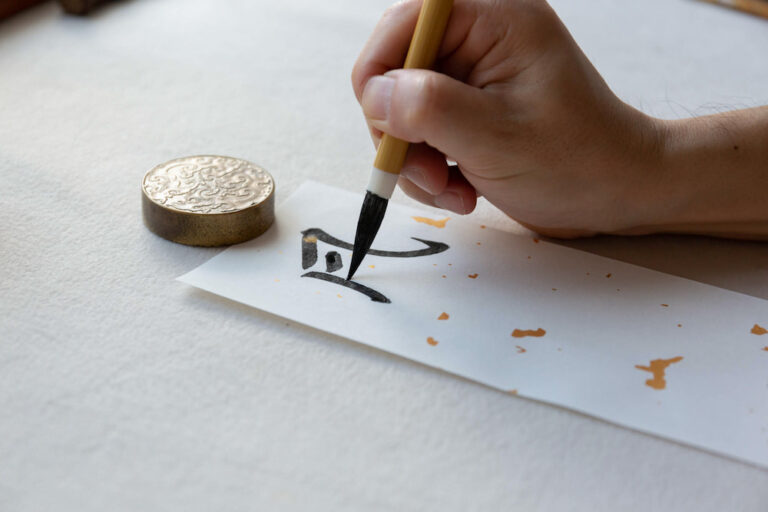
The Chinese brush ranks first among the Four Treasures of the Study. Even in modern people’s studies, brushes remain present, which shows that the brush is the most indispensable of all study supplies.
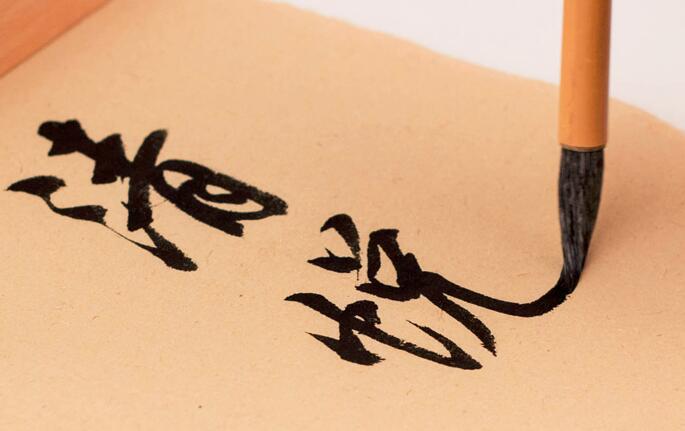
Qi Ming Wen Fang Qingyue Chinese Brush (A Scattered-Tip Brush)
From currently excavated artifacts such as painted pottery patterns and Shang Dynasty oracle bone inscriptions, we can find traces of brush strokes. Therefore, we can conclude that thousands of years ago, our ancestors already used Chinese brushes. However, brushes from that time may have been quite different from modern brushes.
By the Spring and Autumn and Warring States periods, various states were already making and using writing brushes. At that time, Chinese brushes had many beautiful names. For example, the Wu state called them “bulü,” the Yan state called them “fu,” and the Chu state called them “xing.” Only the Qin state called them “bi” (brush). After Emperor Qin Shi Huang unified the six states, “bi” became the standard name and has been used ever since.
Although legend says that the Chinese brush was invented by Meng Tian, a general of Qin during the Warring States period, I believe this claim may not be entirely accurate. It’s more accurate to say that Meng Tian improved the Chinese brush.
There’s an interesting story about this improvement process.
At that time, Qin general Meng Kuo was leading troops in the Zhongshan area in a prolonged war against the Chu state. To keep the King of Qin informed of the front-line situation, Meng Tian regularly wrote letters to report back. At that time, people used sticks (thin rods or flat pieces made of bamboo or wood, quite hard) dipped in ink to write on silk cloth. Writing was very slow, and these sticks didn’t hold ink well – you had to dip them after writing just a few strokes. Meng Tian found this tool very unsatisfactory and wanted to improve it. After repeated experiments, he used lime water to remove the fat from rabbit hair in the Zhongshan area and made an easy-to-use brush.
Currently, the main materials used to make Chinese brushes include wolf hair (weasel tail hair), goat hair, and purple hair (rabbit back ridge hair).
More Articles About Chinese Brushes:
Top 10 Chinese Calligraphy Brushes: The Ultimate Guide to Selection and Care
How to Identify a Genuine Langhao (Wolf Hair/Weasel Hair) Brush
The Four Virtues of Chinese Calligraphy Brushes: Tip, Roundness, Evenness, and Resilience
Best Calligraphy Brushes for Beginners: Complete Guide to Choosing Your First Writing Brush
How to Choose the Right Chinese Calligraphy Brush Size for Your Writing
2. The Second Treasure: Chinese Ink
Today, people commonly use bottled liquid ink to create calligraphy and painting works. Many don’t know that long ago, there was no ready-made liquid ink available. People had to grind ink sticks themselves.
If you’ve watched historical Chinese dramas, you’ve definitely seen scenes like the one shown in the image below.
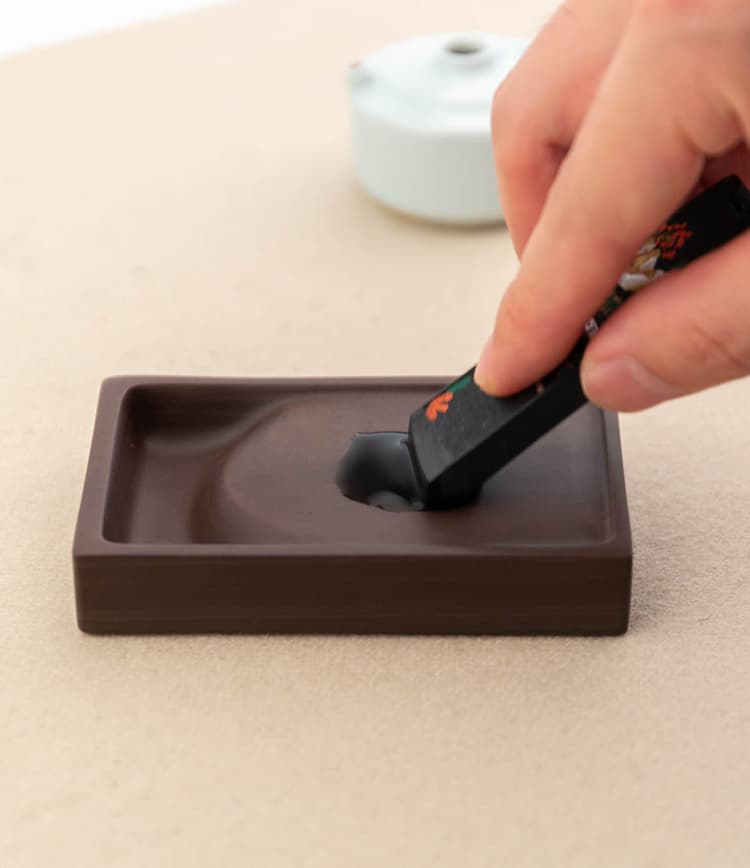
You add an appropriate amount of water to an inkstone, take an ink stick, and grind it back and forth on the inkstone. The ink stick gradually dissolves in the water, producing liquid ink.
In the Ming Dynasty, Tao Zongyi mentioned in “Records from South Village” that “in ancient times there was no ink; people dipped small bamboo sticks in lacquer to write.” This means that in ancient times, there was no ink, and people used small bamboo sticks dipped in tree lacquer to write.
He also mentioned that “in the middle ancient period, people began using stones to grind ink,” meaning that by the middle ancient period, people began using two stones to grind ink.
It wasn’t until the Wei and Jin periods that people began using ink pellets, like those shown in the image below.
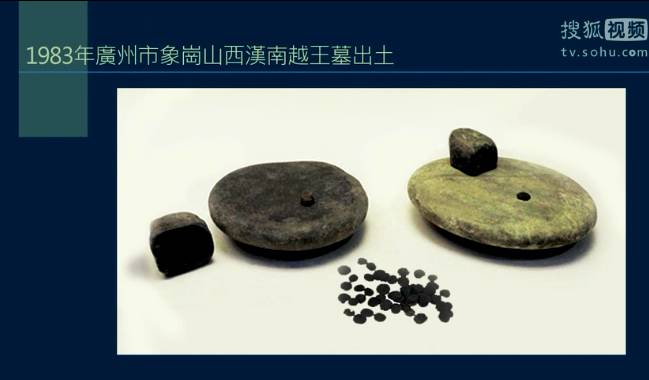
Inkstone and Ink Pellets from the King of Yue’s Tomb (Image from Huang Jian’s Basic Calligraphy Course)
From about the Eastern Han Dynasty through the Ming Dynasty, pine soot ink (made by burning pine trees to obtain carbon powder) was the most commonly used type of ink.
Starting in the Ming Dynasty, oil soot ink (made by burning oil to obtain carbon powder) began to be widely used.
It wasn’t until the Qing Dynasty that a man named Xie Songdai (founder of Yidege ink) invented liquid ink. Because people no longer had to spend a long time grinding ink before writing, liquid ink became extremely popular and has continued to be used to this day.
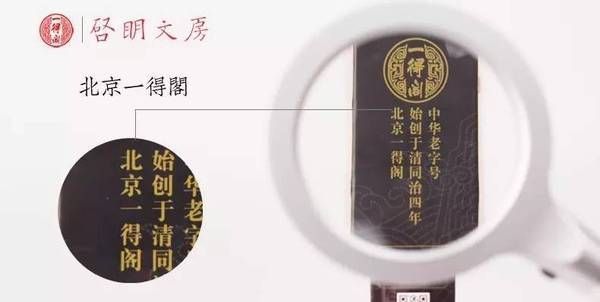
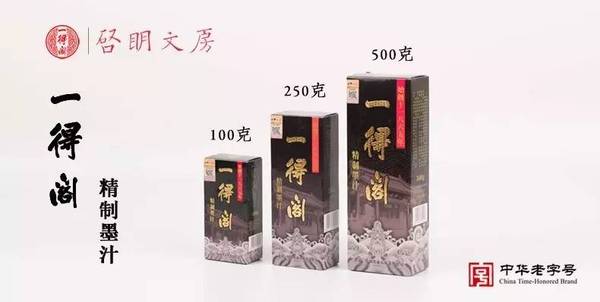
Yidege Liquid Ink, Founded in the Fourth Year of Tongzhi in the Qing Dynasty (1865)
More Articles About Chinese Ink:
The 5 Best Chinese Ink Brands: Properties, Selection Criteria & Care Guide
Chinese Calligraphy Ink: Ink Stick vs Liquid Ink Guide
How to Judge Ink Stick Quality and Grind Ink Properly
How Ancient Chinese Ink Was Made: Oil Soot vs Pine Soot
Beginner’s Guide to Make Calligraphy Ink with an Ink Stick & Stone
3. The Third Treasure: Paper
Paper is one of the Four Great Inventions of ancient China. Before paper was created, people used many different materials as carriers for written text.
Initially, they used knotted ropes to record events – when something happened, they would tie a knot in a rope.
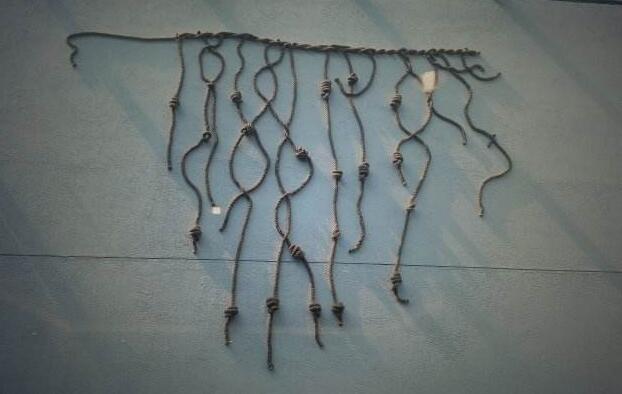
Knotted Rope Record-Keeping
I’m sure everyone knows about oracle bone script – characters carved on turtle shells and animal bones. Because there was no paper at that time but things still needed to be recorded, characters were carved on turtle shells and animal bones.
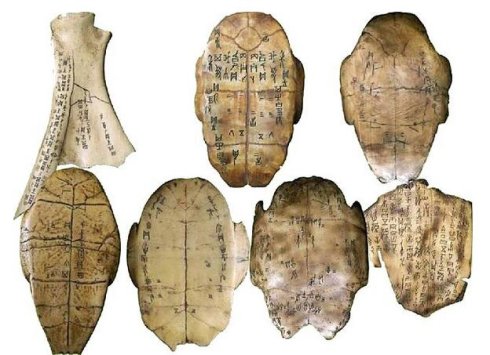
Later, characters also appeared on bronze vessels (called bronze inscriptions or bell and tripod inscriptions), bamboo and wooden slips, silk cloth, or stone.
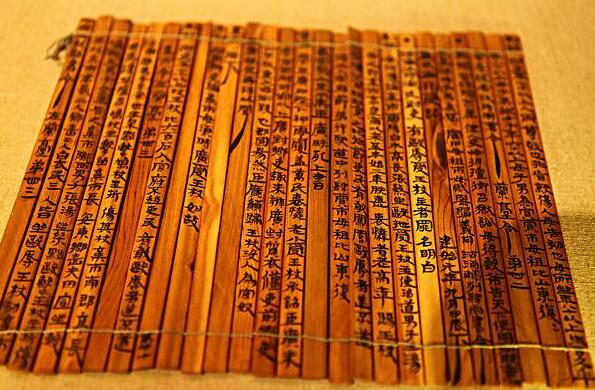
Bamboo Slips
Although history books say that paper was invented by Cai Lun of the Eastern Han Dynasty, I believe this claim, like saying the Chinese brush was invented by Meng Tian, isn’t entirely reliable. We can only say they may have made significant improvements to these items.
Based on current archaeological findings and the chronological order of excavated ancient paper, paper can be arranged as follows: Fangmatan paper from the early Western Han Dynasty, Baqiao paper, Xuanquan paper, Maquanwan paper, and Juyan paper from the middle Western Han Dynasty, and Hantan Po paper from the late Western Han Dynasty.
All of these papers are older than Cai Lun, and some even have characters written in ink on them. This is sufficient evidence that paper already existed before Cai Lun.
Currently, the most common types of paper on the market are Xuan paper from Anhui, machine-made Maobian paper from Jiajiang, and handmade Maobian paper from Fuyang.
More Articles About Chinese Calligraphy Paper:
Top 10 Chinese Xuan Paper Brands: Selection Guide & Care Tips
How to Fold Xuan Paper for Chinese Calligraphy: Complete Size Guide and Folding Methods
How to Prevent Ink Bleeding When Writing Chinese Calligraphy on Xuan Paper
Maobian Paper Guide: What Is It and How to Choose Quality Paper
Best Paper Types for Chinese Calligraphy Beginners – Complete Guide
4. The Fourth Treasure: The Inkstone
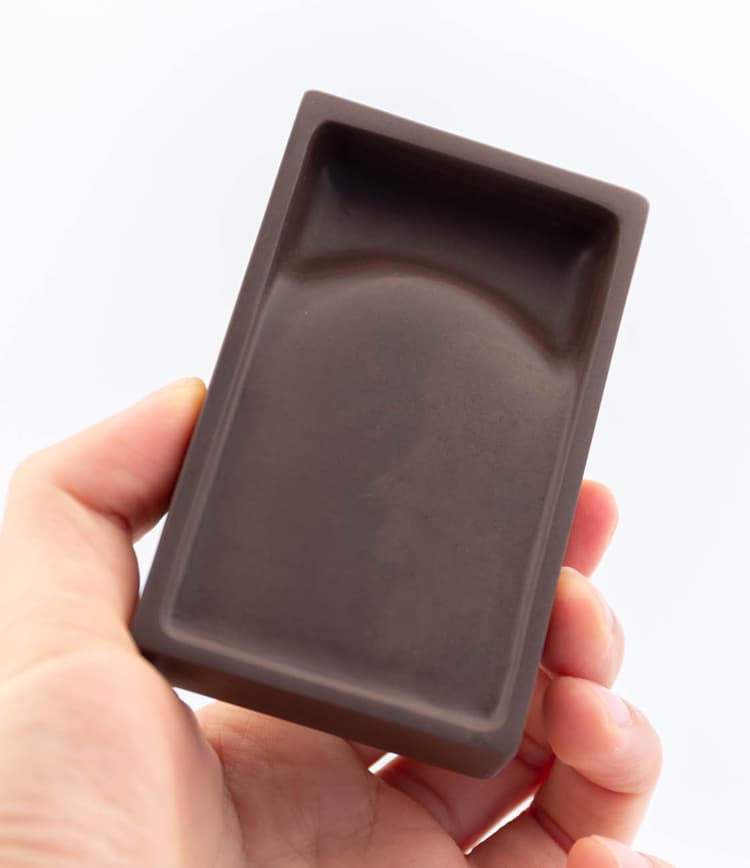
Beiling Red Duan Inkstone from Qi Ming Wen Fang
An inkstone is used to grind ink and hold liquid ink. Of course, there are also some ornamental inkstones that are generally not used for grinding ink – their ornamental value is higher than their practical value.
Currently, the earliest inkstone discovered by archaeologists was excavated from a primitive society site in Jiangzhai, Lintong County, Shaanxi Province. It’s a stone inkstone with a lid, with a slightly concave grinding surface. It came with a stone grinding pestle, and several pieces of black pigment were left beside the inkstone. This was clearly an early inkstone form used by our ancestors to grind pigment with a pestle.
During the Han Dynasty, people invented ink blocks that could be ground directly on inkstones. From that time on, stone grinding pestles gradually disappeared from history.
Materials for making inkstones include pottery, clay (such as Chengni inkstones), brick and tile, metal, lacquer, porcelain, and stone. Nowadays there are even plastic ones, but the most common are still inkstones made from natural stone.
More Articles About Inkstones:
Who Invented the Hotpot Inkstone?
I believe that through the above introduction and related reading materials, you now have a basic understanding of the Four Treasures of the Study. If you want to learn more detailed knowledge about the Four Treasures of the Study, you can follow my website. I will continue to update articles about the Four Treasures of the Study.