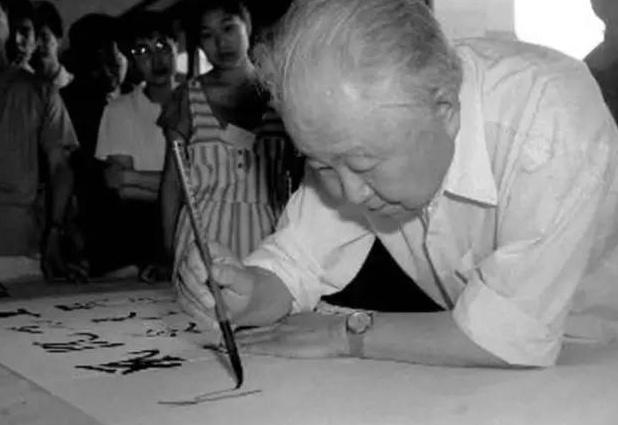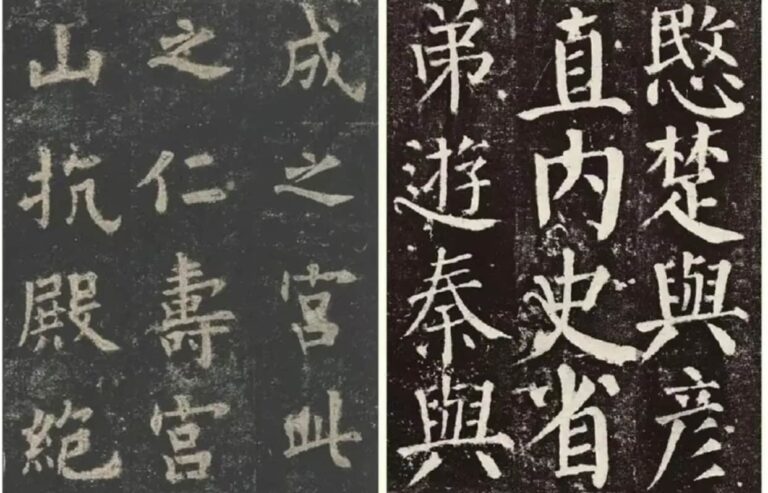
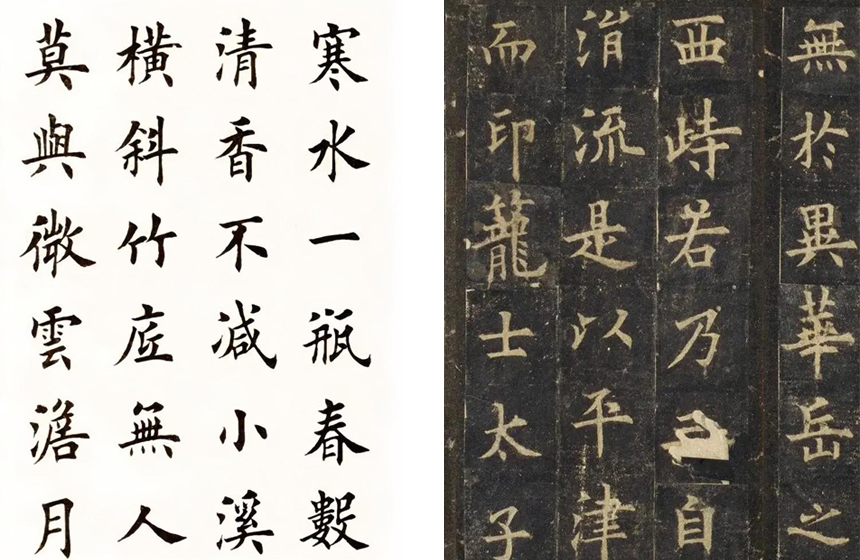
The calligraphy styles of teachers Tian Yunzhang and Tian Yingzhang have always sparked considerable debate in the Chinese calligraphy community. Fans of these two teachers praise them enthusiastically, while critics dismiss their work harshly.
Many people wonder: what exactly is the difference between Tian Yingzhang’s modern regular script and traditional Ouyang Xun style? What characteristics does Tian Yingzhang’s approach have compared to classical Ouyang Xun calligraphy?
Let’s explore this article together, hoping it will help everyone gain a deeper understanding of learning either style of Chinese regular script.
Full text as follows:
The Foundation of Tian Yingzhang’s Regular Script
The mainstream foundation and roots of Tian Yingzhang’s regular script lie in Ouyang Xun’s style – this is widely recognised. Tian Yingzhang’s regular script is rigorous and standardised, strictly follows traditional rules, and demonstrates great skill in Chinese brush techniques.
Can we consider Tian Yingzhang’s characters as the standard Ouyang Xun regular script? Of course not.
Historical Context Shapes Calligraphy Style
Ouyang Xun lived through three dynasties – Chen, Sui, and Tang. His family fell from being a prestigious household to complete execution during his father’s generation. Living under others’ roofs, despite his vast learning, he wandered from place to place, serving under various rulers, including those of the Sui Dynasty, Dou Jiande, Li Yuan, Li Jiancheng, and Li Shimin.
Although he eventually encountered prosperous times during the Tang Dynasty, he ultimately built his reputation only through literary work and calligraphy. We can say Ouyang Xun’s life was full of hardships and unfulfilled ambitions.
In comparison, Mr Tian Yingzhang was born into an artistic family. From childhood, he learned Chinese calligraphy from his father, uncle, and brother. As an adult, he worked in the arts in the military, was selected into the China Calligraphers Association, served as a document calligrapher appointed by the State Council, taught at famous universities, and won numerous calligraphy awards.
He held exhibitions in various countries and became a multimillionaire in the 1980s. We can say Mr Tian Yingzhang’s life has been smooth sailing and commercially successful. This results from talent plus hard work, and of course, we cannot exclude an important factor – the times made it possible.
From this perspective, it’s easier to understand why Tian Yingzhang’s characters have more gentle elegance, standardisation, and regulation than Ouyang Xun’s characters, while having less bold steepness and rich variation.
Evolution of Chinese Brush Techniques
It should be pointed out that in terms of pure brushwork, Ouyang Xun had already moderately simplified the techniques of the Wang Xizhi and Wang Xianzhi system (though he showed unique creativity in character structure). This is also a common characteristic of Tang Dynasty regular script.
In fact, this became even more pronounced with later calligraphers like Yan Zhenqing and Liu Gongquan (though their regular scripts added some decorative brush techniques in starting and ending strokes).
In reality, when later generations learn from predecessors, especially when mainly studying one master, those who are good at summarising and learning often grasp the key points while overlooking variations.
As for Tian Yingzhang’s regular script, it further simplified Ouyang Xun’s brushwork techniques. Tian Yingzhang’s style basically inherited the typical writing methods of Ouyang Xun’s calligraphy while abandoning some of Ouyang Xun’s variations.
In terms of character structure, Tian Yingzhang’s approach tends more toward standardisation and doesn’t pursue some of Ouyang Xun’s dramatic variations.
If we say Ouyang Xun standardised the regular script of the Two Wangs while introducing Northern Stele style elements, then Tian Yingzhang standardised Ouyang Xun’s regular script while introducing modern aesthetics.
Detailed Comparison: 9 Key Differences Between Tian Yingzhang and Ouyang Xun
The following section explains the main differences between Tian Yingzhang’s modern approach and Ouyang Xun’s traditional style. It should be noted that differences don’t necessarily mean one is better or worse than the other.
1. Dots (Side Brush Technique)
Taking the standard dot as an example, Tian Yingzhang’s regular script emphasises a “three corners and one belly” shape, with the Chinese brush moving directly from upper left to lower right. Tian Yingzhang’s summary is quite accurate – Ouyang Xun’s right dots are indeed basically in a “three corners and one belly” form, very vivid.
However, Ouyang Xun’s dots aren’t all “three corners and one belly.” There are still quite a few right dots with various forms that aren’t strictly this shape. Tian Yingzhang’s right dots are basically unified into the standard “three corners and one belly” form.
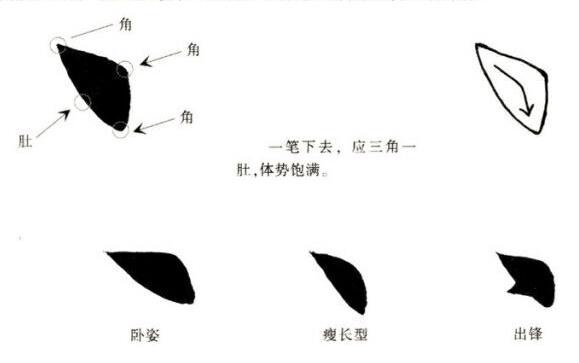
The four-dot water radical shows the most significant difference between Ouyang Xun and Tian Yingzhang. Tian Yingzhang’s distinctive feature is a heavy ending on the last dot – the final dot is noticeably larger than the other three dots. In comparison, Ouyang Xun takes a balanced approach.
For left-right dots, there’s a similar situation – Tian Yingzhang’s right dot is generally significantly larger than the left dot.
Relatively speaking, Tian Yingzhang’s dots are more standardised and unified, while Ouyang Xun’s characters have richer variations.
2. Horizontal Strokes
Tian Yingzhang uses small, pointed horizontal strokes at a much higher rate than Ouyang Xun. Therefore, Tian Yingzhang’s characters appear lighter and more agile, full of brush spirit, while Ouyang Xun’s are steady and vigorous.
The difference in long horizontal strokes between Tian Yingzhang and Ouyang Xun is also obvious. Ouyang Xun’s are flat and straight (typically the bottom edge curves upward while the top edge curves downward or remains flat). Tian Yingzhang absorbs some characteristics from Yu Shinan and Zhao Mengfu – long horizontal strokes generally have the bottom edge curving upward, while the top edge also curves upward or remains flat.
3. Vertical Strokes
Tian Yingzhang uses curved-head vertical strokes (diagonal start with the Chinese brush, thick at the top and thin at the bottom) at a significantly higher proportion than Ouyang Xun’s characters. Where Tian Yingzhang uses curved-head verticals, Ouyang Xun sometimes uses verticals with less thickness variation between top and bottom.
This is especially common in semi-enclosed structure characters (shell-shaped characters).
4. Left-Falling Strokes
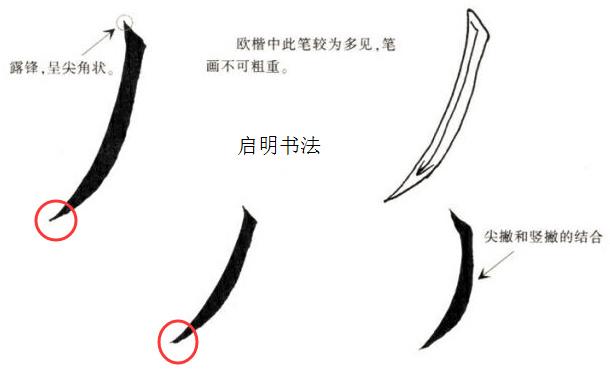
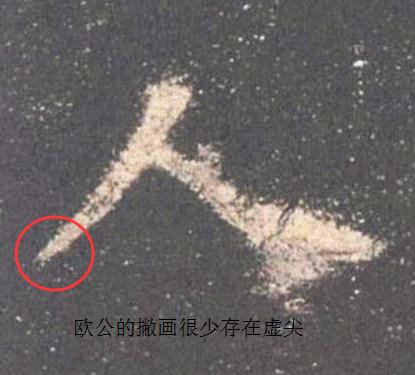
In terms of left-falling strokes, Tian Yingzhang’s characters are noticeably more agile and graceful than Ouyang Xun’s characters, while Ouyang Xun’s are steadier. Of course, this may also be due to differences between stone rubbings and original works.
From a modern aesthetic perspective, Tian Yingzhang’s left-falling strokes are more beautiful. However, Tian Yingzhang’s characters often show excessive tapering at the tips. My understanding is this may be a habit or casualness, because there’s no doubt Tian Yingzhang has the complete ability not to write such tapered tips.
5. Right-Falling Strokes
The difference in right-falling strokes is generally that Tian Yingzhang has standardised them. In Tian Yingzhang’s standard right-falling stroke using the Chinese brush, the “bottom edge” angles toward the upper right, the “top edge” angles toward the lower right, and the blade direction tends to exit horizontally, with the brush tip having a small downward pressing motion at the end.
Tian Yingzhang’s characters are almost all like this, while Ouyang Xun’s are generally like this but sometimes make exceptions.
6. Floating Goose Hook
Ouyang Xun’s floating goose hook carries a strong clerical script flavour and is a characteristic of his regular script style. However, this stroke is quite difficult to write with a Chinese brush. Many who write in the Ouyang Xun style often don’t write this hook ideally.
Tian Yingzhang’s floating goose hook is also very distinctive – square outside and round inside, agile and beautiful. But the difference between Tian Yingzhang and Ouyang Xun is still obvious: Tian Yingzhang’s hook is basically the standard square-outside-round-inside form, with the hook tip generally pointing straight upward.
Ouyang Xun’s hooks sometimes are square outside and round inside, sometimes round both inside and outside. The hook direction is often angled toward the upper right, and the hook’s form also differs somewhat from Tian Yingzhang’s.
Personally, I find Tian Yingzhang’s upward hook very beautiful. My only question is when writing this hook with the Chinese brush, the brush hairs often twist, and I wonder if this relates to using the side-brush technique.
7. Ge Hook (Including Back-Throw Hook)
Tian Yingzhang writes the ge hook with even more distinctive features, generally unified as square outside and round inside, and the exit point is usually noticeably thicker and heavier than the middle and front sections. Ouyang Xun also generally uses a square outside and a round inside, but the thickness variation throughout the hook isn’t as great as Tian Yingzhang’s.
Ouyang Xun’s ge hook isn’t absolutely square outside and round inside – it doesn’t have the uniformity of Tian Yingzhang’s style.
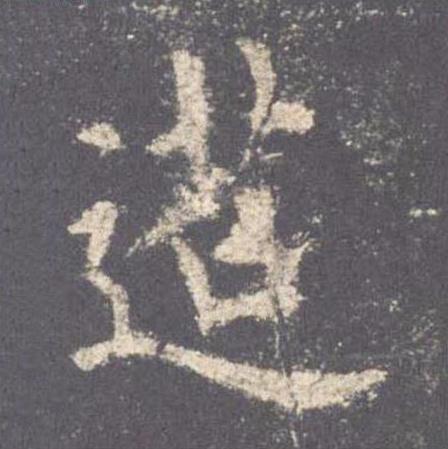
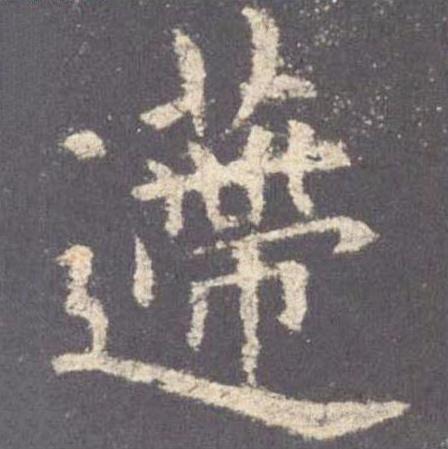
8. “辶” Radical (Walking Radical)
When Tian Yingzhang writes the “辶” radical, he almost uniformly writes the horizontal-turn stroke, so it nearly overlaps. This is Tian Yingzhang’s characteristic writing method, completely different from Ouyang Xun’s standard conventional writing method.
9. Horizontal-Turn Strokes
Ouyang Xun’s regular script horizontal-turn strokes generally connect naturally – that is, the horizontal and vertical components of the horizontal-turn each maintain their own form. Tian Yingzhang’s horizontal-turn strokes often have a noticeable protrusion at the turning point.
Ouyang Xun’s style generally doesn’t have this, occasionally appearing only when the vertical stroke of the horizontal-turn is very short (small horizontal-turn strokes).
Strengths and Limitations of Tian Yingzhang’s Calligraphy
Tian Yingzhang’s characters are beautiful, relatively standardised and unified, and easy to start learning. With dedicated effort in Chinese calligraphy practice, you can write them convincingly in a relatively short time, even to the point of near-perfect imitation.
Some of Teacher Tian Yingzhang’s students write his style so well that, without looking at the signature, it’s almost impossible to distinguish from Teacher Tian Yingzhang. Of course, their skill level is far below Teacher Tian Yingzhang’s.
Teacher Tian Yingzhang is dedicated to spreading regular script calligraphy – his contribution is immense. Friends writing in Ouyang Xun’s style who like Tian Yingzhang’s style can carefully study the characteristics mentioned above. Those not interested in Tian Yingzhang’s style should also pay attention to these characteristics to avoid developing this style unintentionally.
Tian Yingzhang’s regular script is rigorous and standardised, pursuing the ultimate perfection of strokes, with obvious characteristics. But things have opposite aspects. Tian Yingzhang’s strengths precisely constitute its weaknesses.
In the late Qing Dynasty, Huang Ziyuan standardised and regularised Ouyang Xun’s style, attracting massive imitation by beginners. But ultimately, due to low artistic quality, it wasn’t recognised by later calligraphers. Tian Yingzhang’s style is much more beautiful than Huang Ziyuan’s regular script, but it’s also seriously formulaic – much standardisation but little variation.
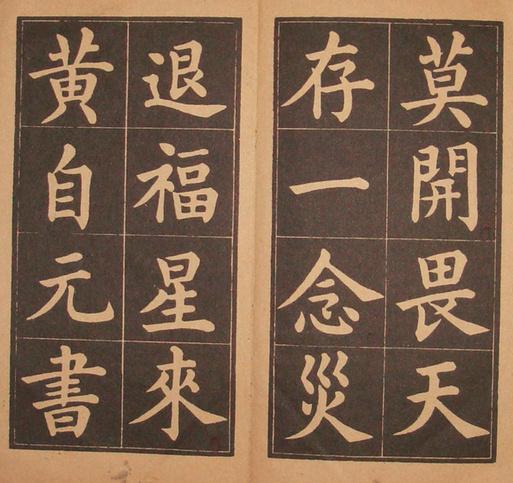
Huang Ziyuan’s calligraphy was not recognised by later calligraphers due to excessive standardisation and lack of variation.
The Problem with Excessive Standardisation in Tian Yingzhang’s Style
In the same piece of Tian Yingzhang’s calligraphy work, repeatedly appearing characters are written almost identically, with no differences whatsoever. Basic stroke writing styles are also obviously formulaic. See one character and know the whole sentence; see one sentence and know the whole piece; see one piece and know everything.
After all, Chinese calligraphy is different from mere writing. Without differentiation and variation, when everything is identical, it’s no longer true calligraphy. Lacking artistic quality, it easily causes visual fatigue. Tian Yingzhang’s style looks good but doesn’t remain interesting over time.
Looking at works by some famous Chinese calligraphers, examining individual strokes or single characters, it’s relatively easy to spot some flaws. But looking at the entire work, it’s full of spirit and energy, inspiring great admiration.
Tian Yingzhang’s style pursues ultimate perfection for individual strokes and single characters, but complete works lack sufficient rhythm and vitality.
Some people say Tian Yingzhang’s writing looks as neat and standardised as printing. Hearing this comment, I wonder how a calligrapher would feel.
Teacher Tian Yingzhang has been immersed in the Chinese calligraphy world for decades with great skill, and his regular script has a far-reaching influence. If he could add more variation, reduce formulaic patterns, and push his style to a new height, it would be the greatest blessing for those who study and love Ouyang Xun’s style.
To borrow a phrase, it might be: “It’s not that he cannot, but that he chooses not to.”
But regardless, Tian Yingzhang’s style is undoubtedly one of the most influential and powerful schools within Ouyang Xun’s regular script tradition, with far-reaching impact.
The above is one perspective.
Qi Ming’s Thoughts:
I want to borrow a quote from Austrian political economist Joseph Schumpeter to explain my view on the value of the two Tian teachers’ regular script. Schumpeter said, “The rise of individuals. The evolution of capitalism/market economy is not about the queen getting one more pair of silk stockings, but about all female workers being able to afford silk stockings.”
Similarly, I believe the popularity of Tian Yingzhang’s style is not about professional calligraphers having one more reference, but rather its standardised writing principles giving all Chinese calligraphy beginners an additional entry method. Those truly aspiring to master regular script calligraphy will not stop at Tian Yingzhang’s style!
You May Also Like:
Master Chinese Brush Calligraphy: Two Essential Stroke Techniques Explained
How Did Ancient Chinese Calligraphers Hold Their Brushes?
Top 10 Chinese Calligraphy Brushes: The Ultimate Guide to Selection and Care
Why Slender Gold Style Isn’t the Best Choice for Beginners in Chinese Calligraphy