To learn Chinese calligraphy, you must master the “center-tip brushwork” technique! Chinese culture has always emphasized the principle of balance and moderation, and calligraphy is no exception. Today’s article focuses on the importance of center-tip brushwork. I think the content is excellent, so I’m sharing it here with everyone.
In Qi Ming’s view, for most beginners who tend to use side-tip brushwork, you can never overemphasize the importance of center-tip technique. Once you become an expert, you’ll probably find this article’s content quite basic.
The full text is as follows:
The Foundation of Calligraphy
The basic skill of calligraphy can be summed up as mastering the “center-tip” technique.
Practicing center-tip brushwork is like training your internal strength in martial arts—it’s the foundation for all moves and techniques.

Although calligraphy includes other brush techniques, these are all fundamentally built on the center-tip foundation. When problems arise with other techniques, you can usually trace the cause back to issues with center-tip brushwork. This is similar to how an athlete’s basic training continues to influence their competitive performance.
Training Timeline and Approach
Developing stable center-tip brushwork typically takes two to three months of practice, though this can vary from person to person.
You can start with seal script (such as “Yishan Stele”) to improve your stroke quality and practice concealing the brush tip while training basic brush control and stability.
After mastering center-tip technique, you can move on to clerical script (such as “Zhang Qian Stele”) to strengthen your lifting and pressing movements and practice square brush strokes.
Next, you can choose a Wei dynasty stele (such as “Zhang Menglong Stele”) as a bridge to regular script, which will strengthen your brush power.
Finally, you can focus on copying a Tang dynasty regular script work (by Yan Zhenqing or other master calligraphers), or study more ancient small regular script (Zhong You’s small script).
If you want to challenge yourself further, you can also choose Wei-Jin dynasty Wang Xizhi and Wang Xianzhi style running script as your deeper learning path.
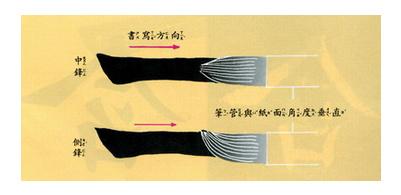
Center-tip brushwork diagram
The Importance of Following the Correct Sequence
Following this training sequence is extremely important. Some calligraphy enthusiasts may practice for years without getting past the center-tip hurdle. Their strokes remain thin and lack substance.
Center-tip practice may seem boring at first, but if you stick with it, your stroke quality will improve dramatically and efficiently.
As ancient calligraphers said, “brushwork creates structure, and structure creates brushwork.” Sometimes it’s simply a matter of basic technical problems with your brush technique. When done correctly, strokes appear round, substantial, and solid. Center-tip is the most fundamental brush technique in calligraphy.

Wang Xizhi, Yang Ningshi, and Zhang Jizhi all wrote the same character “书” (shu, meaning “calligraphy”), but different brush methods produce different effects.
Understanding Center-Tip Through Metaphors
Ancient calligraphers compared center-tip brushwork to “drawing with an awl through sand.” When you drag a sharp object across sand, the cross-section shows a triangle shape—narrow at the bottom and wide at the top. This demonstrates that the stroke’s power is always centered along the line.
You can also carefully observe a car window when it rains. As raindrops slide downward, they fall following their momentum, point by point forming a line—that’s also an example of center-tip effect. Each water droplet can stop at any moment.
When writing, the ink flows through the longest and sharpest part of the brush tip, spreading evenly and reaching all sides, creating a full and complete stroke.
The Power of Control
In fact, as long as the brush can stop steadily, the brush tip will naturally be concealed. When you appreciate the work of ancient master calligraphers—especially classic pieces by Zhang Xu, Wang Xizhi, Wang Xianzhi, Huai Su—even at their most flowing and dynamic moments, if you magnify the end of a single stroke ten times or more, it still looks like a sports car that has firmly applied its brakes, full of power yet completely controlled.
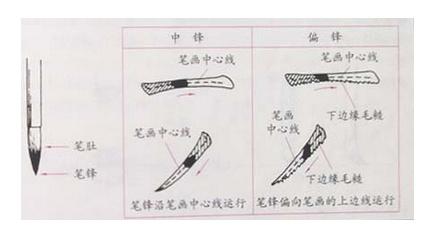
Key Points to Observe
Finally, pay careful attention to observing the “connecting points” and “empty spaces” within characters—you can never be too detailed about this.
Connecting points are where one stroke meets another stroke, and these are often crucial to a character’s structure and details.
Empty spaces are where energy and rhythm flow. When a character looks very different from the model you’re copying, studying the empty spaces often provides the answer.
Four Simple Words, Profound Impact
The basic challenges for calligraphy beginners can be summed up in four simple concepts: center-tip, stopping steadily, connecting strokes, and observing empty spaces.
The path to mastering any craft is similar. Start with the correct method, add consistent effort, and you’ll gain enjoyment and motivation from continuous achievements and pleasant surprises. If your method is wrong, you’ll quickly exhaust your enthusiasm and eventually give up because you can’t sustain it.
Enjoying the Journey
Everyone should enjoy the process of practicing calligraphy. Practice for at least half an hour every day to calm your emotions and benefit your body and mind.
Characters reflect the heart. When you make a stroke full, powerful, and smooth, you must have achieved even breathing and a peaceful mind.
Learning calligraphy isn’t about becoming someone who writes prettier characters than others. Rather, through repeated practice and direct communication with ancient masters, you learn refinement, character, patience, and taste.
Most precious of all, you learn to appreciate countless styles of brush and ink, and to appreciate this rare abstract beauty in our results-driven world.