Kai Shu (regular script) and Xing Shu (running script) are the most common scripts in our daily lives. From childhood, our textbooks are printed in Kai Shu, and book covers often feature Xing Shu or Li Shu (clerical script) because these styles are easy to read. Because of this, many calligraphy beginners assume they should start with Kai Shu or Xing Shu. However, in Qi Ming‘s view, Zhuan Shu — also known as seal script — is actually the best place to start. Let me explain why, covering the brushwork, structure, learning logic, and what famous calligraphers throughout history have said about it.
1. Simple Brushwork Is Why You Should Start with Seal Script Calligraphy as a Beginner
The core technique in seal script is called “zhong feng” — center-tip brushwork. This means the tip of the Chinese brush must stay in the center of each stroke at all times, never exposed to the sides. This technique produces strokes that are firm, round, and visually balanced. It has long been considered the foundation of all Chinese calligraphy brushwork.
In seal script, the way you start, move through, and finish each stroke is relatively straightforward. Unlike Li Shu, there are no wave-like flicks at the ends of strokes. Unlike Tang Dynasty Kai Shu, there are no sharp pauses or pressing movements. The basic building blocks of seal script come down to just three elements: dots, straight lines, and curves — mostly round in form, with round starts and round finishes.
To put it simply: once you master the round-start, round-finish technique, you are halfway to learning seal script. The other half is the structural rules, which we will cover next.
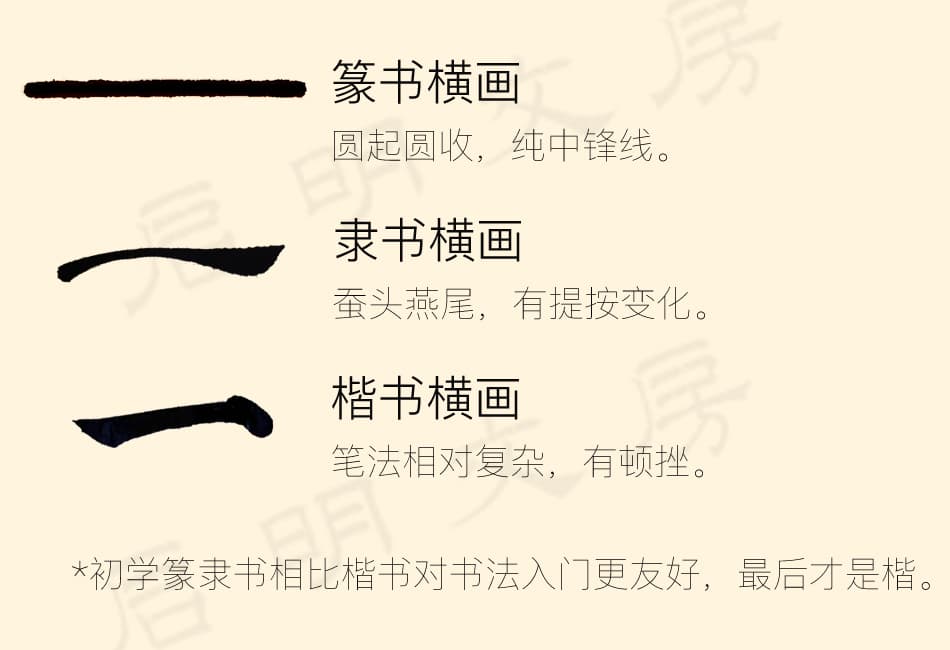
▲ A comparison of horizontal strokes in seal script, clerical script, and regular script
2. Seal Script Has Simpler Structural Rules Than Other Scripts
For beginners with zero calligraphy experience, seal script is not only easy in terms of brushwork — its structural rules are also easier to grasp. Small seal script (Xiao Zhuan) is built on the principles of symmetry, balance, and gradual variation.
When it comes to symmetry, it goes beyond simple left-right mirroring. The angles of curved strokes on both sides mirror each other, the tilt of each side matches the other, and a single stroke placed in the center is often lengthened or shortened to stay visually balanced with the strokes around it.
Take the character “行” (meaning “to walk” or “travel”) as an example — it is perfectly symmetrical left to right, with the center stroke adjusted in length to match both sides.
By practicing seal script, beginners naturally develop a sharp eye for the shape of Chinese characters and a strong sense of spatial balance. This becomes a solid foundation for learning Li Shu, Kai Shu, Xing Shu, and Cao Shu (cursive script) later on.
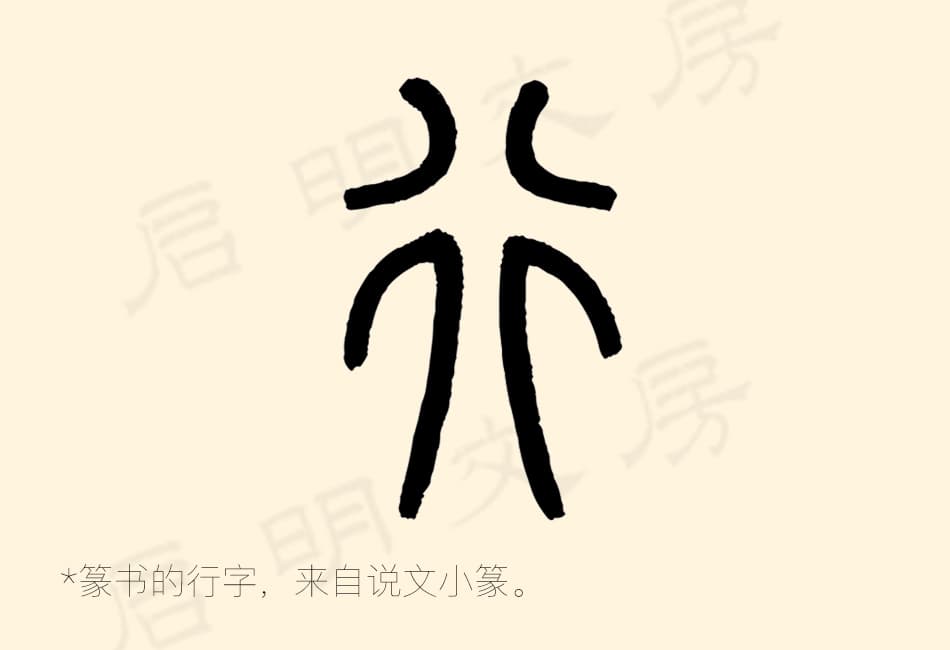
▲ Seal script is known for its strong emphasis on symmetry
3. Starting with Seal Script Matches the Natural Learning Progression
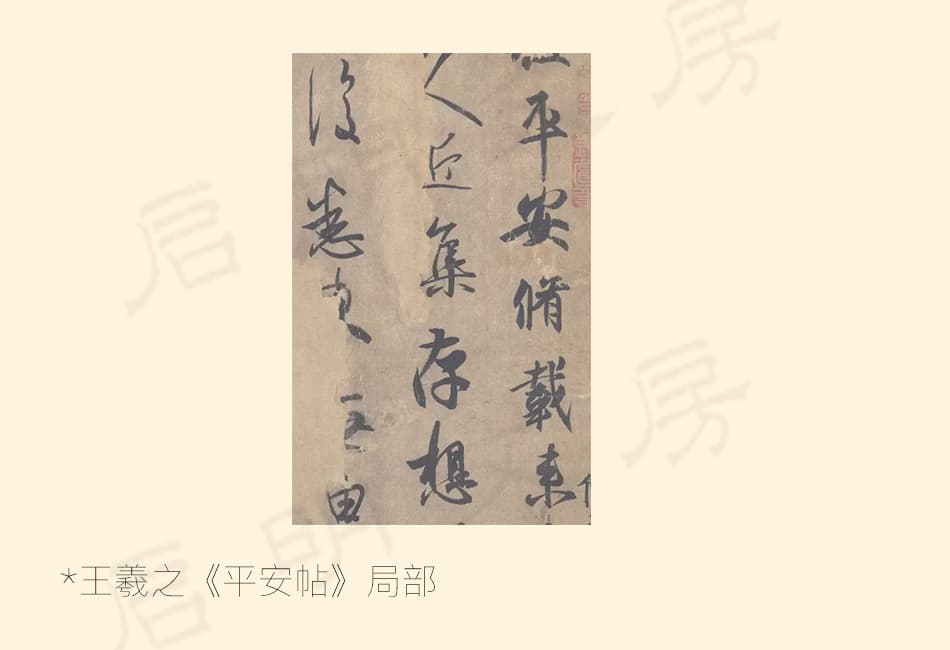
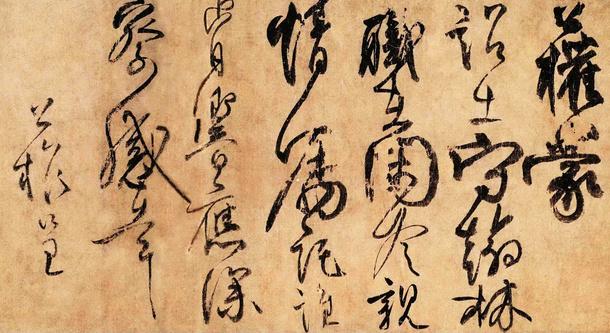
▲ A detail from Wang Xizhi’s Ping An Tie
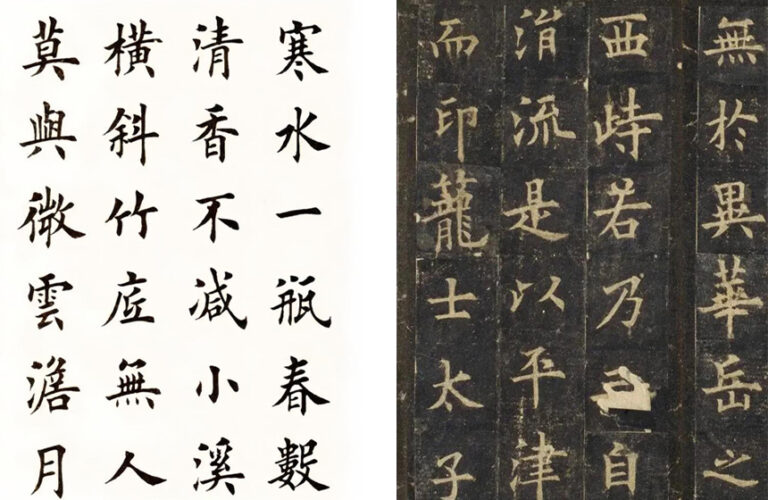
Take a look at this image — it is a section of Ping An Tie, a famous work by Wang Xizhi, one of the greatest calligraphers in Chinese history. You can feel both the speed of his brushwork and the wide variety of pressure and rhythm in each stroke. For a complete beginner, trying to manage both speed and complex brushwork at the same time is simply too much to handle at once.
Qi Ming once learned breaststroke from a swimming coach. The coach did not immediately teach the arms, legs, and head movements all at once. Instead, he first had Qi Ming practice each part separately on land — the pull, the turn, the kick, the squeeze — before putting it all together in the water.
Seal script works the same way. Because the brushwork is simple and the structure is symmetrical, it is very well suited for slow, deliberate practice. (Honestly, it would be hard to write seal script as fast as running or cursive script anyway.) Writing slowly lets you really feel how the Chinese brush hair touches the paper, and you start to notice how even subtle changes in your breathing or hand pressure affect the quality of the line. This kind of sensitivity becomes a key asset when you move on to other scripts.
Think of learning seal script as mastering one individual movement in a larger routine. Once you have that one movement down, everything else comes faster. For example, when you move on to Li Shu, you really just need to stretch the vertical seal script forms into a wider, flatter shape and add the characteristic “silkworm head and wild goose tail” stroke endings — and you will pick it up quickly.
4. Master Calligraphers Throughout History Have Recommended Starting with Seal Script
This is not a new idea. Calligraphers in ancient China strongly valued the study of seal script as a foundation.
For example, a famous text called Bi Shi Lun Shi Er Zhang (Twelve Chapters on Brushwork Principles) — attributed to Wang Xizhi, though scholars believe it was written in his name by later authors — records Wang Xizhi advising his son Wang Xianzhi to dedicate serious effort to studying Zhuan Shu and Zhou Wen (an ancient script form). The message was: it may seem like extra work, but it actually saves time in the long run and makes success easier to achieve. Although the strokes in seal and Zhou scripts are complex-looking, the brushwork method itself is simpler than in Li Shu, Kai Shu, Xing Shu, or Cao Shu. Starting here makes it easier to master center-tip brushwork. By learning and absorbing the best qualities of various masters, your characters will become clear, and your brushwork will develop a strong, expressive energy. Once you have solid seal script lines, learning other scripts will naturally lead to a distinctive personal style.
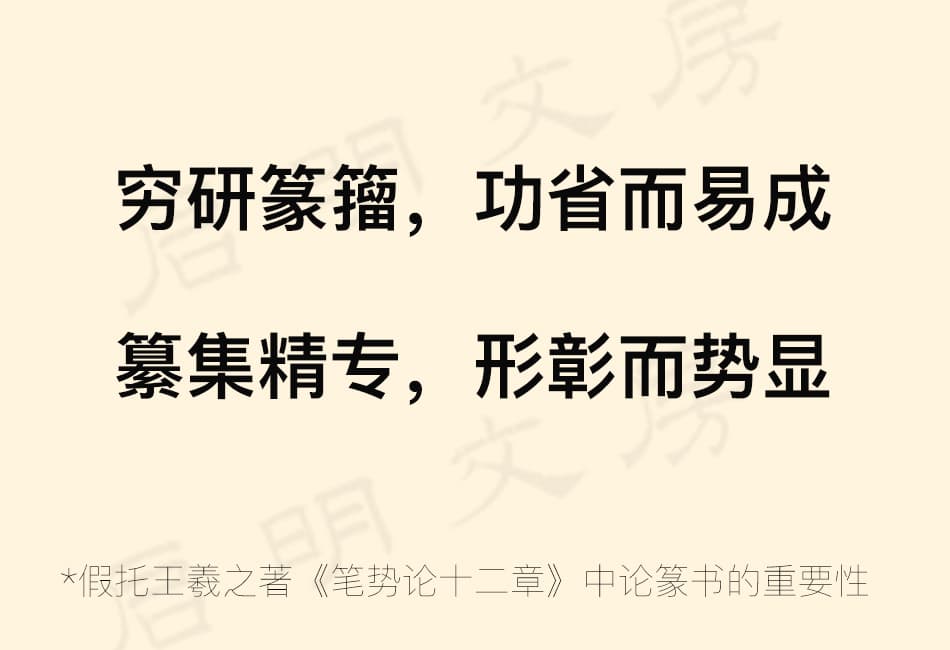
▲ Bi Shi Lun Shi Er Zhang, attributed to Wang Xizhi, emphasizes the importance of seal script
Even Emperor Li Shimin of the Tang Dynasty praised this approach. In his biography of Wang Xizhi written for the Book of Jin (Jin Shu), he criticized many calligraphers for their weaknesses, but singled out Wang Xizhi with the highest praise, saying: “He studied ancient and modern works thoroughly, and researched seal script deeply — achieving the highest level of excellence.”
Furthermore, both the China Academy of Art and the Central Academy of Fine Arts begin their professional calligraphy programs with seal script. In Professor Qiu Zhonghong’s well-known book Chinese Calligraphy: 167 Exercises, after introducing how to hold the brush and practice movements in the air, the very first on-paper exercise is practicing center-tip lines, which are exactly what seal script strokes are made of.
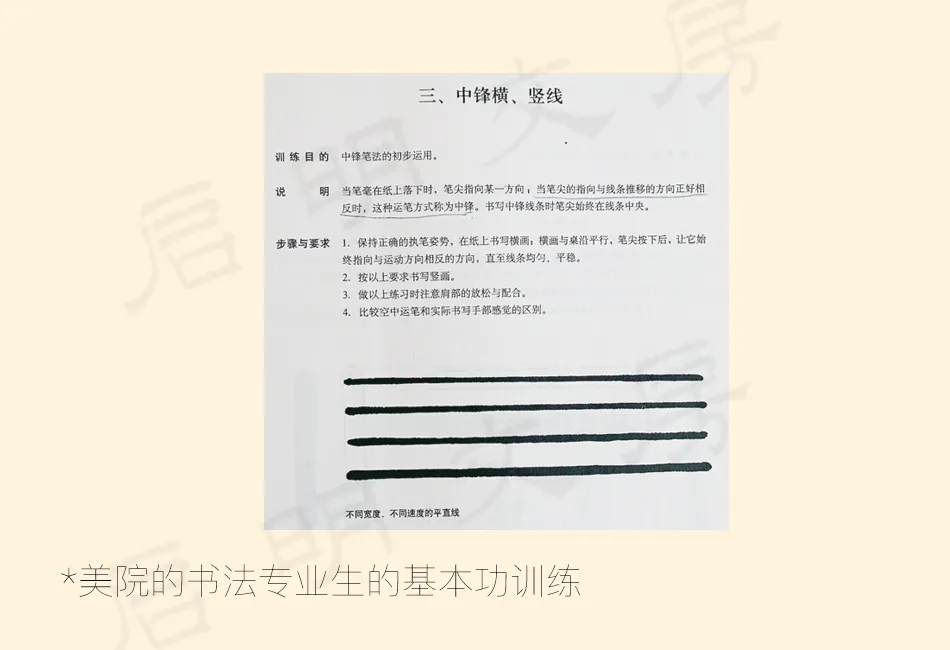
▲ The third exercise from Chinese Calligraphy: 167 Exercises
The above is Qi Ming’s advice for calligraphy beginners, based on personal experience. In short, starting with seal script is a solid choice — it builds a strong foundation for all the scripts that come after. As for which practice copybooks (zi tie) and tools are best for beginners starting with seal script, Qi Ming will cover that in a separate article. If you found this article helpful, feel free to share it with friends who love calligraphy!